All posts by georgedallam

Is training “hard” the best way to create improvement in performance?

One of the most fundamental questions in regards to how to apply training in triathletes concerns the widely accepted and implemented belief that training works best when it is “hard”.   This is commonly expressed by the expression “no pain, no gain”.  I was certainly raised in this belief and can still remember the wide spread admiration of both my teammates and coaches in my ability to push myself to the point of “puking” during swimming training sessions in high school during the 1970s.  I carried this belief forward through some 20 years of my competitive athletics career until sometime in the late 1980s when the twin issues of both exercise induced bronchoconstriction and frequent overtraining became so chronic that they threatened to derail my ability to continue as an adult triathlete.

To really understand the question of whether or not we should strive to train “hard” a starting place is a discussion of what we mean by training intensity.  Most athletes and coaches think of training intensity in terms of what they feel or experience during training.  However that concept should more appropriately be thought of not as the intensity of the training but as the effort associated with creating/performing a given training intensity.  More logically the training intensity is the actual rate of work being performed.      In cycling for instance, riding at 200 watts (power and rate of work are the same thing) represents the training intensity of that ride.   A heart rate of 140 or a perceived effort on the Rating of Perceived Effort (RPE) scale of 14 represent the effort, both physiological (heart rate) and perceptual (RPE rating), associated with performing that work intensity.

A second widely held belief associated with the “no pain, no gain” concept of training, is that the amount of effort we feel drives the outcome – harder efforts result in improved fitness outcomes or adaptation.    This might be understood in the context of the widely held belief that failure sets in weight training result in more improvements in strength for instance because in forcing the muscle to fail we are somehow creating a “better” stimulus for adaptation.   However this concept has been widely debunked by this 2016 meta-analysis and review  https://link.springer.com/article/10.1007/s40279-015-0451-3 which support the idea that in short term training programs using more controlled approach  to weight training (basically sets not resulting in failure at the same weight or training intensity) creates the same performance gaining adaptations as an approach which employs the far more effortful failure approach to training.   Further, a closer review of the long term studies (more than 12 weeks) reveals greater improvements in the controlled approach, although these differences do not turn out to be statistically significant in the meta analysis for the most part as such studies are few.

A practical interpretation of this is quite simply that training in a way which requires too much psychological effort and is also exhausting is far harder to carry out consistently then training which feels more comfortable and is not as exhausting.  In short term research projects the “team’ effect and completion incentives will help offset this problem in the treatment groups using failure training for a time, allowing the failure groups to achieve similar results to the non-failure more controlled approach groups, but in the longer studies the failure group subjects begin to drop out more and or simply become overtrained.     Anecdotally, in the real world of weight training a big day of your buddies pushing you to failure sets is probably one of the best predictors of future training program drop out.

A more involved question goes directly to the concept of whether the stimulus for performance improvement is a function of the volume and intensity (training load) of local muscle work performed alone or the physiological outcomes associated with it; such as the degree of acidity you experience or the level of oxygen uptake (VO2)  achieved.    The long term bias in the science of exercise physiology has been to focus on the physiological outcome side of the picture and develop training approaches which reflect the optimal stimulus for those outcomes versus strategies that maximize the amount of work performed at the targeted velocity or power without undue fatigue.   This is expressed by concepts such as lactate threshold training, VO2max velocity training, lactate (really acidity) tolerance training and weight training to failure.    Each of these approaches is based on the theory that using the training intensity and duration that produces the greatest degree of change in a fundamental physiological limiter to our ability to provide metabolic energy (such as the maximum amount of oxygen we can provide, acidity we can tolerate or lactate we can clear sustainably)  becomes the best way to progress training adaptations to high levels.    However, In practical application this means performing at the work intensity for as long as possible, which of course then results in both a large of degree of psychological discomfort during training as well as extremely high fatigue post training.

An alternate view of this concept is that the more important stimulus is the cumulative work performed at a given work intensity, regardless of the level of oxygen transport, acidity or lactate clearance achieved.    In the weight training realm this might be expressed as follows.  If a given athlete could squat a 1 repetition maximum (RM) of 200 pounds, he might then perform failure sets at 85% of that 1 RM at 160 pounds.   Typically this would result in about 5-8 reps in the first set to achieve failure with subsequent sets almost always falling off in the number of repetitions completed prior to failing.  Rarely would more than 3 sets be completed.  Such training is very demanding psychologically, requires longish rest periods between sets  of several minutes or more to complete and is very fatiguing.   Those who have engaged in such a training approach over time of time also know how much mental effort is required just to begin each training session as well.

In a more controlled approach to training the same athlete might simply do lower repetition sets (-2 reps from failure ideally) at the same training intensity (weight of 160 lbs.).  In so doing each set is relatively easy to complete as acidity and central nervous system fatigue is greatly reduced, rest periods are greatly reduced (often to around a minute or less in my experience) and a far greater number of sets can be performed, typically meaning the total volume of training at this training intensity (160 lbs) can be increased.   At a minimum, the previously mentioned research suggests this approach will allow for the same gains in strength/power/muscle mass while training in a way which can more easily be perceived as enjoyable.  Over time the improved training consistency associated with this approach is likely to result in a greater net gains in strength, power, hypertrophy, etc..

This concept has not been directly addressed in the endurance portion of the training continuum.   However, one study looking at the best training protocols to improve VO2max using the velocity of running at VO2max (VVO2) indirectly illustrates the same idea.    https://link.springer.com/article/10.1007/s00421-003-0806-6   This study used the concept of adding twice  weekly interval training in two treatment groups of moderately trained runners at differing percentages of the time limit over which the velocity at VO2max can be maintained in a given athlete;  with a third control group continuing to train normally.     A higher percentage of time limit meant the athlete ran longer at the target intensity in each interval , likely then experiencing more acidity and discomfort during each effort as well as spending a greater time during the interval at VO2max.   The first treatment groups training protocol used six intervals run for a duration of 60% of that athletes time limit at VO2max velocity once weekly .  The second treatment group ran five longer intervals for a duration of 70% of time limit at VO2max.  While these differences seem small, they are critical;  just as the last few repetitions in a weight training set approaching failure are critical to determining just how hard that effort feels , how much fatigue the effort will create, and how much rest will be needed prior to recovering for the next work set or interval effort.   The rest of their weekly training was controlled aerobic running and not progressed.      In both cases the athletes were not running until complete exhaustion at 100% of time limit at VO2max velocity meaning the interval sessions were hard but doable – think about how you might feel about lap three of a 1600 meter time trial at your best effort.   In addition, the amount of time spent running at VO2max velocity (not maximal oxygen uptake) was equated by using fewer interval repetitions in the group doing the longer intervals.   Conventionally, we would then expect a better training response to come from the longer interval training set group, whereby more time was logically spent at VO2max.    However, the shorter interval group was the only group to improve significantly in a 3000 meter time trial (17 secs versus 6 secs in the other treatment group and no change in the control group) suggesting that the need for increased oxygen uptake and discomfort was probably secondary to the amount of running actually done at the target velocity and the ability to adapt more readily to the less intense interval training session.   Basically what this study suggests is that a more doable training approach (shorter, less discomfort inducing intervals at the same relative velocity) results in better adaptation to high intensity interval training than an approach which is more likely to create more exposure to the physiological stimulus but is also more difficult to do.  Further, Veronique Billat, the most heavily invested researcher on the topic of training at the minimal velocity at which VO2max is achieved, demonstrated in a classic training study using intervals at 50% of the time limit to VO2max at that velocity that such an approach can be implemented to great effect and without creating overtraining. https://europepmc.org/article/med/9927024

Anecdotally I became fully convinced of the utility of using this concept (focusing on work achieved at the target intensity in relative comfort versus maximizing physiological stimulus) during my coaching use of supplemental oxygen in creating a high/low training model for the athletes I coached for many years in Colorado Springs at the Olympic Training Center (picture on this websites home page).  In particular, Hunter Kemper successfully progressed from running approximately a 5:10 minute per mile pace to running a 4:35 minute per mile pace during 4 minute intervals over several years by breathing a 50% oxygen concentration mixture, which changed his expected RPE during such efforts from 15 -17 down to typical RPEs of 12 or less .   Essentially this approach decoupled his normal sense of effort and associated acidity and heart rate from the actual work intensity he was performing in training, yet it still translated to progressive improvements in 10 kilometer triathlon running until he eventually became one of the fastest triathlon runners in the world.  Of course he not only tolerated these sessions well but actually looked forward to them.

Of course the rest of us in the real world can’t afford to train with supplemental oxygen , so how can we practically implement  the concept of training at progressively higher work rates but always at reasonable perceptions of effort?  The simple answer is to employ interval training using only intensities and durations that represent your current ability, versus trying to train as hard as you can in any given context.  For instance, if my current ability allows me to run a mile time trial in 6 minutes, when I want to train to improve that specific performance ability (which relates quite closely to VO2max velocity) , I would then design an interval set to be run only slightly faster than my current ability with intervals short enough to be relatively comfortable to perform.    Here I suggest two rules.   First, only work slightly faster (less than2%)  than your current ability.  For a 6 minute miler that might mean running at a 5:52 pace.   Second, break the work up into at least 4 intervals.   For example, to train for a 1600 meter effort,  run intervals of 400 meters or less, in this example at a 1:28.  Such intervals will be relatively comfortable and allow you to accumulate time at the desired training intensity without undue fatigue, creating a platform for successful adaptation.   I have long referred to this concept with the axiom “the point of training is not to train hard, but to train so that you can do harder work”.  Of course this applies in both swimming and cycling as well.   The only real trick is to have valid idea of how fast you can perform at a given distance, which is normally established through either through time trials or racing, as most of us do not have the time or expertise to translate data from physiological tests.  However, there are also reasonably accurate, particularly in experienced athletes, methods to predict current performance ability at longer distances using shorter distance tests and then applying a logarithmic function in something like Excel.    I initially presented this approach in Championship Triathlon Training in 2005.  It can be understood by considering the following sample graph created in excel.
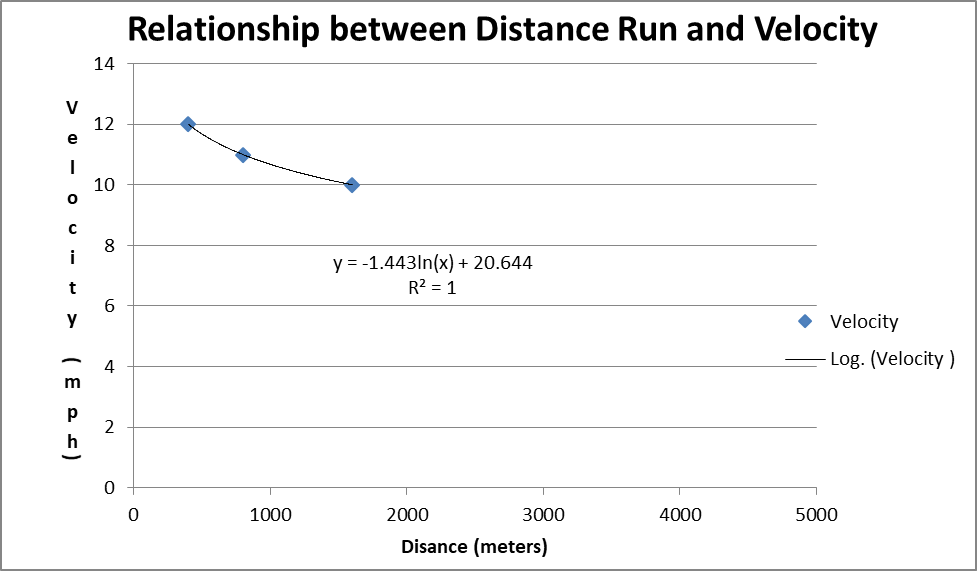
Figure 1 -Running Distance (X) and Velocity (Y)

In this athlete who ran 400 meters in 1:15 (12 mph) and 800 meters in 2:43 (10.99 mph) he would be predicted to run 1600 meters in 6:00 (9.99 mph).      To determine his 5000 meter pace (or any longer distance pace) we would then just use the log function and insert the distance as x to get the mph as Y.  

So for instance -1.443 * (LN 5000) + 20.664 = 8.35 mph or a 5000 meter time of 22:18.   This athlete is reducing his velocity 8-9% each time he doubles distance, a concept I refer to as his fatigue rate.   The fatigue rate lowers as we adapt successfully to greater volumes of training reaching 4-6% in elite triathletes (based on my past coaching and testing) and even 2% in world endurance running record holders, such as those who have held the 5K and 10 K world records simultaneously.   It is more typically 15% in typical college athletes (I have measured many hundreds) and as high as 25% in more sedentary people (some of my students are sedentary).    This variation is why it is so important to measure at least two distances and not just apply the standard tables which are largely based on trained collegiate distance runners with fatigue rates of 6-7%.

Once a reasonable target training intensity for a given distance is established, then one can apply the rule of at least 4 parts to develop a training set (more as the intended distance increases) . When implementing such a set the point is to replicate the desired intensity (even when that feels too easy 😉 and not try to improve upon it. In running, for instance, this done in the easiest manner by using a treadmill (where pace can be controlled externally). However the same can be achieved using power, GPS or even the time honored stop watch and measured distances. Lastly, the concept is applicable to any distance of training and builds on the well established principle that intervalized training is our most effective tool for making training progressions to become the idea that “controlled” interval training is more effective than “unrestrained” interval training.

Notes on Reflexive Performance Reset (RPR) – an applied use of Reflexology.

Compensatory Movement Patterns – ZacCupples.com

Reflexology may work by changing the resting activation state of muscle resulting from the stimulation of receptors in the skin, fascia and muscle at the point of pressure application resulting in localized relaxation (reduced activation) in muscle associated with the points used for the external massage – the reflexology points.  Several theories exist for how this happens.  I personally favor the theory that the approach is working though the central nervous system by activating afferent receptors which in turn send effector stimuli to the muscles which induces relaxation.  https://www.takingcharge.csh.umn.edu/explore-healing-practices/reflexology/how-does-reflexology-work

How is reflexology likely to be beneficial?  First by generating a relaxed state throughout the body, overall sympathetic activation will also be reduced and the body moved into the parasympathetically dominant state necessary for healing and recovery to proceed efficiently, particularly if combined with slow nasal breathing practices. 

Reflexive Performance Reset (RPR) is an emerging specific use of certain reflexology points associated with specific muscle groups as a “warm-up” or pre-activity activation technique.   This process is thought to reduce compensatory movement patterns acutely allowing for more effective movement.  While videos demonstrating this phenomenon appear to increase the activation of targeted muscle groups, the more likely explanation is that they are actually reducing the activation of opposing (antagonistic) muscles group which are in a higher than optimal activation state and which are reciprocally inhibiting the activation of the agonist as a result.   By deactivating the tension state we see an immediately enhanced ability to recruit an associated agonist resulting in more force potential, increased dynamic range of motion and favorably altered joint positioning (posture).   This would explain why is important to use the RPR massage point for both agonists and antagonists in a given movement pattern and or generally  throughout  the body in daily practice.

In example, in training yesterday I ran the longest workout of recent months (1:25 combined running and elliptical cycling), swam my longest workout of recent months (3,000 yards) and completed my normal strength training following.  The weight training includes both hex squats and weighted back extensions, weighted but kicks, among others.

After sitting and reading this morning for an hour or so I felt the usual over firing of my hip flexors upon standing resulting in extreme movement stiffness, and that locked down lordosis (lumbar curve) and forward tilted pelvis position those who sit for long periods are probably familiar with, exacerbated by my level of fatigue in the associated muscle groups (from the previous days heavy training) as well.  I lay down and went through an initial six nasal breaths followed by the sternal, rib cage, back of head and ears, upper abdominal and lower abdominal RPR activation massages.   Upon standing, the previously described restrictions were completely gone and I was able to achieve complete relaxation, ideal posture around my hips and the ability to move without any restriction without doing anything else.   The primary qualitative sensation I can describe is the incredible state of relaxation I could feel in muscles which just minutes prior were at that level of activation just prior to full spasm.   Of course the contrast felt somewhat astounding.  

The experience stimulated the following spontaneous clarity in regards to how RPR might work – a concept I have been thinking about since beginning to use the technique.   The principle of reciprocal innervation is a long held and studied concept which is widely used and accepted in practitioners of proprioceptive neuromuscular facilitation (PNF) stretching.  Basically this principle is that an increased contractile state in one muscle group reciprocally inhibits via reflex the ability to contract a paired muscle group.  In PNF practice we then deliberatively innervate one muscle group to relax the associated agonistic muscle group – i.e. flex your quadriceps to relax your hamstring.   We also know intuitively and experientially the general relaxation in our muscles which occurs after therapeutic massages – that mechanically stimulating the skin and muscles with our hands induces relaxation in the muscle.   My insight goes to how these two well accepted phenomena might explain mechanistically how RPR working to improve movement acutely.   

I have been using RPR systematically for about 2 years after having initially read about it, figured out how to do it from web based information and then implemented it experimentally before a tempo run.  The result of this personal experiment was an immediate  drop in tempo pace from my recent >9:00 minute/mile  range to an ~8:30 pace (I’m old and slow) ;  a pace I  had not seen for many years in such a training session.  I could also feel what runners call that “pop” off the ground which comes from better glute activation, something I had also not achieved in some time.   I then continued to use RPR daily even after the first published experimental trial was not supportive of any advantage beyond a passive static stretching https://www.journalofexerciseandnutrition.com/ManuscriptUploadsPDF/136.pdf  Despite some cognitive dissonance (I always lecture my students to follow the science) and even though my right brain dominant scientist’s way of interpreting the world told me to me not spend valuable time on  something which evidence did not support, my considerably  weaker left side brain kept reminding me that I felt better  every time I did it.  Interestingly, now more research is emerging which is more encouraging,   https://www.reflexiveperformance.com/rpr-blog/2020/2/4/research-what-weve-learned-and-where-were-going   although none of it is published as of this writing.  If I keep working, I will inevitably design a project to examine this phenomenon myself.  In the mean time I am getting to do the RPR again having sat for a considerable time to write this post ;-).

Some additional thoughts:

RPR is most likely to help you if you have significant muscles imbalances caused by sitting or highly repetitious training and/or exhibit poor movement ability (low FMS scores) or clear postural maladaptation (anterior pelvic tilt, winged scapula, etc.).  The effect will likely also be magnified during periods of heavy training combined with lots of sitting in recovery and may not be apparent at all in a younger highly functional athlete (although this species increasingly ceases to exist).   The most likely best practice use of RPR is just prior to more general dynamic warmup procedures, following  periods of sitting and possibly again later in endurance training sessions as fatigue begins to compromise muscle activation and return one to longstanding compensatory movement patterns.   RPR should also be evaluated as a recovery from training tool.   For instance, this study looking at foot reflexology found increased parasympathetic activation, as measured through increased heart rate variability, following e fatiguing physical testing, in comparison to control. https://www.mdpi.com/2075-4663/7/11/228 

Several  factors should also be considered in designing experimental trials to evaluate the possible effects of RPR.   For instance we might start with populations who have low FMS scores and consider pre-fatiguing them with training in the day before testing effects.  I also see a lot of potential for acute application in those with back pain directly related to muscle firing imbalances aggravated by stress and general muscle fatigue. https://www.sciencedirect.com/science/article/abs/pii/S0965229907000623

Does how you run or cycle affect your performance?

I came to running in triathlon in 1980 as a swimmer first.  In swimming I had learned that technique is everything, so naturally I started trying to find out “how” to run.   However, in the early 1980s hardly anyone considered how you ran as important, so I didn’t have much luck and just experimented.   This led to the inevitable failures and successes but no unifying approach to carry me forward over time ever emerged.

Flash forward to 1996 and the beginning of the USA Triathlon National Teams program which I began as USAT’s first National Teams Coach.   I knew my primary weakness in this job was my ability to improve running technique.   So being the type of athlete and coach who recognizes that you have to develop your weaknesses, and not just rely on your strengths, I made this my primary focus for new learning.   By good fortune, Nicholas Romanov became known to me and we began to communicate.  First I simply tried the simple ideas he was promoting myself with very rapid positive results.   The dominnent things I can remember were that I could suddenly run much faster and that my quads stopped being destroyed by longer runs.   Next we brought him out to Colorado Springs to learn his concept, the Pose Method, first hand and ultimately the basic ideas became the basis for how we coached running in the National Teams program for years.   At its simplest, the Pose Method, Chi Running, and barefoot running all hone in on the same basic idea – that many runners over stride as result of recovering the leg using relatively more hip flexion and less knee flexion (by swinging the whole leg forward like a pendulum), which results in projecting the lower leg and foot well forward of the center of mass at ground contact.   This prevents the runner from absorbing energy elastically with maximum efficiency and creates reactive forces directed upwards through the body initially, rather than reactive forces that propel the body forward, a concept sometimes called braking.   Eventually the full foot does come down to the ground and some energy is certainly absorbed elastically and reactive forces eventually do  become propelling, so these differences are small and hard to see at normal running speeds.

When running without shoes over hard surfaces our bodies revert to a different approach.   Rather than using a pendulum from the hip to return the leg we flex the hip and knee simultaneously and to the same degree (like marching versus walking).  This action lifts the foot in a higher and shorter arc upwards towards the rear end (butt kicking) and results in the foot landing on the ground with the lower leg at a more neutral or rearward angle, and closer to the center of mass, avoiding the phenomenon of “braking” and allowing the midfoot to engage the ground first, followed later by the heel as the ankle dorsiflexes.  Our bodies are clearly designed to land on the midfoot, which then engages the plantar reflex earlier as well as making full use of the ankle as a second class lever to receive and return the forces of gravity which both drive us to the ground with each step and can then be returned to propel us forward elastically.   Essentially, the Pose Method and Chi running are systems to teach us how to do this, should we not be able to simply start running barefoot on hard surfaces all the time.

The simplest biomechanical outcomes of such a change in running technique are simply stride rate and frequency. When we take steps without overstriding, the steps become shorter and must be taken more quickly at a given velocity of running.  Now to the science.

In my research and statistics class my students develop and carry out original research projects every semester as I believe and practice experiential learning – learn by doing. We don’t put these projects through IRB review or publish them – they serve simply as a methodological learning technique.   In one of my favorite projects over the years we tested barefoot versus shod running over 100 meters on a turf football field to see which was fastest (hand timed), using a within comparisons approach – each student ran in both conditions with order randomized.   Further, we counted steps and then used simple calculations to determine stride rate and length.   The result were that students ran significantly faster barefoot (about 3/10ths of a second for 100 meters) using a higher stride frequency and shorter step length than when running shod. Astoundingly, such basic science on this elemental question has never been done or published, at least to my knowledge.   This study suggests we can run faster barefoot when the surface for running is not inhibitory to doing so.  In so doing our mechanics change by increasing stride frequency and taking shorter steps.

As I described in my first post to this blog, sport science rarely creates new advances in technique or training.    Rather, it usually just helps us to understand why they do or do not work.    The focus in sport science, to its detriment, is quite often only on the mechanism (how something works), and not on the outcome (how do you run fastest in this instance).   The largest example of this is the huge body of literature on running economy.   Running economy (versus mechanical efficiency) is simply the idea of measuring how much oxygen is required to run at a given steady state pace.  In activities like cycling we measure mechanical efficiency – how much oxygen is used to perform a given rate of work or power, because we can directly measure work.   But until recently, rate of work or power could not be measured in running, largely due to the fact that running employs elasticity to a large degree to achieve the outcome – how fast you run.  Consequently measuring economy (oxygen cost at a constant running velocity) is a default position.

We think economy is very important to running success – largely because running economy helps explain performance differences amongst homogeneous runners of high ability.  Here is the classic study on this topic: https://www.researchgate.net/profile/Gary_Krahenbuhl/publication/15744615_Running_economy_and_distance_running_performance_of_highly_trained_athletes/links/59d698f8aca27213df9e81b4/Running-economy-and-distance-running-performance-of-highly-trained-athletes.pdf

In addition, a long history of sport scientists manipulating stride frequency and stride length, going back into the 1970s,  has consistently shown that increasing someone’s stride frequency and reducing stride  length, in comparison to their freely chosen approach, increases oxygen consumption (makes economy worse).   Here is the most recent review: https://www.ncbi.nlm.nih.gov/pmc/articles/PMC4887549/

Hence, the conclusion in sport science has long been:  “Don’t change someone’s running technique”.  But there is a problem – nobody ever measured the effect of these changes on performance.

When we started using Pose Method performance principles with our currently overstriding elite triathletes, who then inevitably increased their stride frequency and reduced stride length at a given velocity, we nearly always saw their running performance improve.   Two notable cases come to mind.  The first, Hunter Kemper, was a notably overstriding and fairly mediocre NCAA Division I runner his sophomore year when I began to coach him as part of our collegiate program.   You will find he was near the front in the world junior triathlon championships that year off the bike, and then fell back to fifth or so after running about 35 minutes for 10K.   However, Hunter has high motor ability, and with some basic cueing, he returned the next year with a far more Pose like stride and rapidly became a 30 minute 10K runner and conference champion.  By 2005, he was considered the dominant runner in elite triathlon worldwide.  The second, Susan Bartholomew (now Susan Williams), came to elite triathlon following her NCAA swimming career and with an even more pronounced overstride as well.   Similar changes were certainly part of her improved running which later resulted in her becoming the first Olympic medalist in triathlon for the United States.

It was with this mindset that I set out to do my dissertation research examining the effect of the Pose method on biomechanics and economy found here: https://www.ncbi.nlm.nih.gov/pubmed/16195026

This particular study is often referenced by those who continue to choose to accept the “don’t change running mechanics” paradigm because we found that upon increasing stride frequency and reducing stride length in our Pose Method treatment group, as a result of 12 weeks instruction, running economy became worse.  Of course this study can easily be interpreted as simply another study showing that changing away from selected stride frequency and length increases oxygen consumption and makes economy worse.  Further, as a dissertation student, I accepted the instruction of my mentor to “not bother with performance measures”.  However, the problem was that the study subjects in the treatment group kept telling us about anecdotal incidences of performance improvement.   This was so prevalent that I felt compelled to formally survey them after the study about their intent to keep running in the “new way” even knowing that the result of the study suggested that their changes would hinder their performance.  All but one subject in the treatment group said they would continue with the changes, in spite of the study results, citing their own believe that they could run faster in the new way.

I had experienced my own profound running performance gains using this approach so I also never even considered changing back once the study was done.   However, the outcome of the study always troubled me; although I attempted to publish it without bias in any case.

Fast forward once again to more recent times and several things have happened which help me to understand the conflict this work created – how could one become less economic yet able to perform better with a change in running technique that resulted in increased stride frequency?   First, one of my colleagues on the Pose Method study, Graham Fletcher, later published similar work looking at performance, which showed that Pose Method changes do result in relatively short order running performance improvements, as we had consistently experienced. That study is found here: https://journals.sagepub.com/doi/abs/10.1260/174795408786238506

The second development is that we now have technology which purports to measure the power associated with running, although still not directly.    Finally, a pair of physicists and runners using this technology has recently shown that increasing stride frequency and reducing stride length results in a reduced running work rate and an increased oxygen cost at a given running velocity, although they have not yet formally published this work.  A summary can be found here:  https://blog.stryd.com/2019/12/06/the-impact-of-cadence-on-the-running-economy/

Of course by reducing the mechanical work of running at a given velocity by increasing stride rate, possibly as a result of an improved elastic energy return created by recovering the leg in a more spring like manner and landing more efficiently on the ball of the foot, we may be offsetting any negative effect from an increase in oxygen consumption, even in the short term, resulting in better running performance.   Their work does not answer that question, but it does help to explain our outcome and offer a way by which individuals whose economy was clearly worse after changing technique could still be running faster.    Further, with time, the most central way to improve economy begins to work – that being repetition.

One can find another example of this concept in cycling.  While virtually every study of cycling economy shows that pedaling a larger gear at a slower rate reduces oxygen cost, all the way down to about 60 RPMs, no elite cyclist of any note in modern times (lets say the last 30 years) has ever created a new standard in a typical time trial using these kinds of slow cadences.   In fact cadences of 90-100 RPM are more likely to occur.  This recent review highlights the use of increasingly higher cadences as power outputs increase over shorter time trials.

https://www.ingentaconnect.com/content/sabinet/ismj/2009/00000010/00000001/art0000

When we pedal more slowly using higher forces to produce a given rate of work we not only recruit more fatiguing fast twitch muscle fibers, we may also inhibit the interplay between propelling  and opposing forces created at the pedal itself.   Consequently, all competitive triathletes should strive to “learn” to pedal at higher cadences to allow for the possibility of creating higher power outputs and faster time trial performances.

As a practical example of this concept I began my cycling career in 1980 at a time when the 40K national record was around 54 minutes (it was in fact set in my first ever cycling race by Tom Sain, at the Arizona District Time Trial championships).   Over the next couple of decades Tom Doughty lowered the record to 52+ minutes using a huge gear and pedaling at ~60 RPMS.   Following this a long period of record swapping between Kent Bostick (also a U. of Arizona grad) and John Frey (from up the road in Albuquerque) ensued which ultimately dropped the record into the 47 minute range.   In observing this progression (and having had occasion to sit on the wheels of both) the lasting impression left in my mind was how the huge gear slow pedaling style employed by both while in the 54 minute range was ultimately replaced by a smaller gear higher cadence approach as the records got faster and faster eventually reaching 47 minutes.   I will note that the introduction of aerobars also greatly influenced this progression.

My conclusion is that making changes in the running technique of overstriding triathletes, in line with barefoot running, Pose Method and Chi running principles, will increase stride rate at a given velocity and facilitate faster running performance.  This is generally applicable to athletes whose stride frequency is between 60-85 strides per minute during steady aerobic running initially.

As to the method of doing so, great care has to be exercised if a barefoot running approach is used, although this is the simplest approach.   I suggest artificial turf, very limited initial running without shoes and a very slow progression.   As most modern people have spent nearly all of their lives in shoes, the idea that they could simply shuck them and run their normal volumes on typical road and concrete surfaces, without some injury occurring, seems improbable.   When using Chi or Pose method approaches, similar caution should be used to avoid large amounts of calf soreness and or injury initially.   Over time a stride frequency of 90-100 strides per minute at steady aerobic efforts should be the target.

I can further conclude that increasing the ability to pedal at higher cadences in cycling will facilitate a similar potential for performance improvement in that sport as well when one is not able to sustain cadences of 90-100 rpm comfortably.  This is easily accomplished by simply introducing cadence feedback and gradually progressing the maximum cadence at which one begins to “bounce” in the saddle in short efforts, while gradually increasing cadence targets for more extended riding.

Does your ability to move functionally affect your performance?

I think that most triathletes and runners think that their ability to move functionally (think snatch squats dropping below a parallel thigh position) has little to do with their ability to swim, cycle and run over longer distances because these movements require little in terms of mobility or balance or coordination beyond that which nearly any adult human, who is not currently injured, possesses.    Consequently, we devote the vast majority of our time to swimming, cycling and running (particularly cycling 😉 and presume our limits to performance speed come from limits to our training volume and/or genetic limitations on energy production (one has a low VO2max), never even considering the general ability to move as relevant.

Contrary to that idea, those of us who teach and coach swimming often begin to realize over time that individuals  who cannot reach full flexion through the shoulder girdle (extend their arms in the air together and behind their head) seem to have more trouble creating a long and effective swimming stroke and consequently can’t swim as fast.  Those coaches/teachers who are most enlightened then often try to improve this mobility limitation in some way as a way to make it possible to improve swimming technique.

In running and cycling the need for functional movement ability seems even less likely to be meaningful in limiting performance and may even contribute in some ways to improved movement efficiency.    Think tight hip flexors creating an early stretch reflex response during hip extension to recover the foot quickly in running.   One of my college roommates at the U. of Arizona, Keith Englke, participated in one of first experimental studies of this concept, whereby they used stretching to improve the hip extension range in runners and found that this approach actually reduced their stride frequency and made their physiological economy worse (they needed more oxygen to run the same speed).   https://academic.oup.com/ptj/article-abstract/73/7/468/2729171

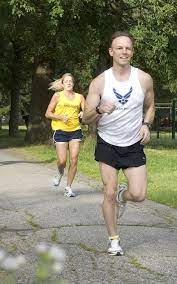
However, as our definition of functional movement has evolved, simple range of motion my not be the only or even the main factor of importance in movement competency.   Beyond this narrow mobility view, the idea of movement compensation has emerged as possibly the most powerful aspect of functional movement ability.   For those not yet versed in this thought process, compensatory movements occur in certain joints when other joints fail to perform their duties in a given movement pattern.   As an example think of the typical post race running photo where you are inevitably caught while in support (one foot on the ground – see above).   In the best runners the pelvis dips only slightly on the non-support side and the rest of the lower and upper body maintain fairly vertical alignment.     In many of us however, the non-supported side of the pelvis drops a few more degrees and pitches forward a few degrees , causing the knee to move inward and rotate, and the support foot to flatten and point outward (pronation) excessively.   All of these compensatory movements place greater stress on the associated joints and clearly predispose us to joint injures and/or overuse syndromes – such as  runners knee and plantar fasciitis.   However, these compensatory joint actions can also be thought of as a source of inefficiency, allowing the energy the body captures from gravity and returns to forward movement via elasticity to be lost or “leaked” away with each step taken.   The analogy I like is of a spring which has lost some of its optimal tension so that when a load is applied the spring collapses too much reducing the energy it can return elastically.

One enlightened physical therapist/strength and conditioning guru, Grey Cook, realized more than twenty years ago that we needed a systematic way to measure/evaluate the occurrence of compensation and movement competency and created an approach now called the Functional Movement Screen (FMS).   His test is based on the performance of seven movement patterns which focus to a greater or lesser degree on core to limb joint mobility (think hips and shoulder girdles), appropriate core activation (both statically and dynamically) and the integration of the two into challenging movement patterns which are most relevant to gait (think snatch squat, step over and lunge patterns).   Each pattern is scored from 0-3 as follows:   (3 pts) can complete the movement successfully without compensation, (2 pts) can complete the movement successfully with compensation, (1) cannot complete the movement (0) the movement causes significant joint pain suggesting injury.

Over the years an emerging body of research makes it clear that in many human activities, having low movement ability as measured by the FMS is associated with a greater occurrence of injury.  https://journals.sagepub.com/doi/full/10.1177/0363546516641937   Note – this does not mean that one can predict injury solely from the FMS score, just as one cannot expect to predict a heart attack solely from a cholesterol score.    Rather, it means that how well you can move is probably one in many factors that predispose a person to injury, so odds of injury increase when you move poorly.

However, the available research has never shown that movement ability as measured by the FMS is even moderately related to performance outcomes. https://journals.lww.com/nsca-jscr/fulltext/2014/12000/Efficacy_of_the_Functional_Movement_Screen___A.34.aspx

Why?   This seems illogical, at least to me.  If differences in movement ability associate with differences in injury occurrence why do they not also relate to differences in the ability to perform?    One only need review the three most typical descriptive studies examining this question to know why.    Each uses a smallish homogeneous sample population, typically a collegiate athletic team, whereby the athletes vary to a relatively small degree in their athletic performance.   Contrast this to actual humans who vary hugely in athletic performance (think the difference between winning times and last finishing times in a triathlon for instance).  In addition, such research sample groups typically vary minimally in movement ability as measured by the FMS as well.   In thinking about how relationships are measured mathematically via correlation, basically the computations address the similarity in ways that the two measures rank those measured across each scale of measurement used.   When everybody measured falls within a narrow band on the scale for both measures being evaluated the chances for ranking congruence go down greatly, meaning it is difficult to find relationships mathematically.

This situation bothered me so I set out to do an experimental study in which I would attempt to improve movement ability, as measured by FMS, while controlling for other factors which we know affect running performance such as running training load and strength/power training, and then see if running performance would also improve.   We selected a population we thought would be low on movement ability in the first place, recreationally competitive runners (as opposed to sub elite/elite athletes), thereby allowing room for improvement in the first place.

We found that our treatment group improved both FMS score and 1 mile running performance with no change in strength, power or training load, while the control group did not change in any of our measures.   https://www.researchgate.net/profile/George_Dallam/publication/331526978_FMS_Corrective_Intervention_Improves_FMS_Composite_Score_and_1-Mile_Run_Time_without_Concurrent_Change_in_Hip_Extension_Strength_Vertical_Jump_or_T-Shuttle_Run_Time_in_Recreational_Runners/links/5c8038ea458515831f8b1378/FMS-Corrective-Intervention-Improves-FMS-Composite-Score-and-1-Mile-Run-Time-without-Concurrent-Change-in-Hip-Extension-Strength-Vertical-Jump-or-T-Shuttle-Run-Time-in-Recreational-Runners.pdf

The intervention followed the ideas developed by Grey Cook himself.   Essentially, we used the FMS to identify compensations and then focused individually on each subject to improve their compensatory movements by improving the specific mobility, core control and integration components specific to each pattern in which they were deficient.   This approach was led by undergraduate students using a relatively simple process that any coach or trainer might apply.

The long and short of the study, in my mind, is that while training, strength/power and genetic ability drive most of what differentiates us in triathlon running ability, poor movement ability begins to act as a drag on performance ability if compensatory movement patterns are present or emerge (it happens to all of us 😉 resulting in lower FMS scores.   As most adult recreational endurance athletes exhibit multiple compensatory movement patterns (think race photos and low starting FMS scores of our subjects and those in other studies of runners) this concept has nearly universal application in triathlon.  If you are coaching or teaching triathletes and/or runners you might want to consider adding the FMS and an approach for reducing compensatory movement to your arsenal of skills.

As to the presence of compensation in the athletes pictured  above.  Clearly and not so much ;-).

Does how I choose to breathe matter?

I like to start with basics, ala John Wooden, as they are so often the platform upon which later success is built. The most basic part of endurance sport is breathing , although the concept is almost never addressed as a learned skill. Most athletes, coaches and scientists default to the position that breathing simply occurs, so however it occurs must be best. During exercise this most often means opening your mouth and breathing as deeply and quickly as needed. I felt this way myself for approximately the first 40 years or so of my currently 54 year athletic career – swimming, water polo, cycling, running, triathlon and a little wrestling thrown in for good measure (I grew up in PA where wrestling is religion ;-). The thing that finally changed my thinking on this was getting sick – literally all of my athletic life. Colds, bronchitis, pneumonia – later sinus infections and exercise induced bronchoconstriction (EIB), starting from my early age group swimming days and continuing until about 14 years ago. Finally, one weekend, sitting around with a sinus infection, feeling like crap and unable to train – I decided to step out of the box. Stepping out of the box meant looking elsewhere for help – in this case the internet – as the train of health care practitioners I’d seen over my life had not helped this problem in the least. Weirdly, I came across two ideas: breathing through your nose while running and using a Neti Pot everyday. So I started doing both. Initially I could barely complete the early and slowest stages of my running warm-up before the urge to breathe (what is called it air hunger in the scientific literature) would force me to open my mouth. However, relatively, quickly I began to notice I could go further before this air hunger appeared. In cycling it was easier and very quickly I could do all of my training this way by simply going a little easier than normal. Over the next 6 months or so I found I was able to build up to doing all of my normal training, at all intensities, breathing nasally, without the sensation of air hunger occurring, while breathing only through my nose (both in and out). Approximately a year after starting this wackadoodle approach I did a corporate cup mile race and bicycle time trial I had been doing yearly for about a decade in faster times than I had ever done before – no mean feat in an aging athlete in his late forties. Beyond this, I went for a period of about 5 years without once getting sick – no colds, bronchitis or pneumonia, sinus infections, no nothing.

Of course this was all anecdotal, so as a scientist/coach I knew it was time to start studying the phenomenon in other people. None of the elite athletes I was working with at the time were willing to give it a solid go. Amanda Stevens, bless her heart, gave it a try one day on a run and then gave me that pitying look young physicians reserve for the very stupid when I asked her about it later. Hunter Kemper never even entertained the possibility, apparently chocking the idea up to idiosyncratic behavior you just accept in someone who has otherwise been helpful to you. However, others, who held me in a higher (although less realistic) levels of esteem just assumed I knew what I was talking about and gave it a serious try – experiencing a similar process to what I had gone through.

Eventually, there was a small cadre of people who had “adapted” to nasal only breathing during exercise and so we began to study the concept formally. We initiated this process as pilot work later published as a case study found here: https://journals.tdl.org/jhp/index.php/JHP/article/view/70

Later, I was able to resource my small group of dedicated nasal breathers, as well as some others I came across, to complete this group study: http://journals.aiac.org.au/index.php/IJKSS/article/view/4400

The basic take away from these two studies is as follows. Not only is it possible to adapt to breathing exclusively nasally while running, without loss in performance, but performance may also be improved as a result of better physiological economy.

The improved running economy we have seen with nasally restricted breathing probably results from the now established observation that nasal breathing provides the required oxygen needed by the working muscles without requiring as much ventilation – actually about 23% less on average – at high levels of work. This idea is referred to as ventilatory efficiency. Ventilation is also a muscular activity and makes up about 15% of the total energy requirement needed to run fast – like at race pace for a 5K. Consequently, if you improve ventilatory efficiency in this way, you then reduce the need for energy and oxygenation and can then theoretically run about 1-3 percent faster as a result. This might turn a 6:00 mile pace for 10 K into a 5:50 pace for instance, just by breathing differently.

The adaptive process requires some extended period of time from about 1- 3 months, whereby you start training breathing nasally only at intensities where you do not feel significant air hunger, and then gradually increase training intensity as air hunger disappears. If you eventually include a full spectrum of intensity in your training, ranging up to aerobic capacity (VO2max) level work ( basically 800 meter to 1600 meter running performance speed in most athletes, depending on ability), then you will eventually be able to run at any pace breathing nasally, including during racing.   In addition, using a nasal splinting device or internal nasal dilator can help you achieve higher exercise intensities in this condition as you adapt.   Later these can be used to boost key training sessions and racing.

The additional benefit of breathing nasally in training and competition is likely be a lower probability of sickness and the prevention or elimination of exercise induced bronchoconstriction (EIB)  . The reduced EIB  outcome has been previously established in those who already have asthma and experience bronchoconstriction during exercise as illustrated here: https://www.atsjournals.org/doi/abs/10.1164/arrd.1978.118.1.65 

In the triathlete case study discussed previously , the subject retained a bonchoconstricitve response while breathing orally which disappeared while breathing nasally.  Anecdotally, I can add that I ‘ve seen several athletes with moderate to severe EIB overcome it by adapting to nasally restricted breathing, including myself.

Finally, there may be range of other exercise related benefits from breathing nasally which are yet to be established including reduced water loss (nasal breathing reduces expired water in comparison to oral breathing at rest), increased parasympathetic regulation (nasal breathing creates greater parasympathetic response at rest)) , reduced tooth decay (nasal breathing retains moisture in the mouth) and a reduced potential for myocardial ischemia (orally dominated hyperventilation induces coronary artery constriction at rest).

There are some minor downsides to breathing exclusively through your nose while exercising.  Initially nasal breathing during exercise produces lots of mucous and efflux meaning you will need to blow your nose more frequently for some time. However, in my experience (14 years nasal breathing during training and racing), this response also diminishes greatly over time.  In addition, I occasionally still get sinus headaches – typically following a rapid change in temperature from hot to cold in the very low humidity conditions where I live combined with a long day on the bike. This might be attributable to simple dehydration , but it may also be exacerbated by the increased need for humidification in the nasal cavity when breathing nasally.   Of course the parallel response when breathing orally is significant post exercise coughing and probable tissue damage in the lung.  

If you decide to try this be patient – it takes some time to adapt – however, in my experience it has been worthwhile.  

Does performance lead science or does science lead performance?

Welcome to my blog which is focused on the interaction between science and performance with particular reference to the sport of triathlon. Briefly, I began my journey as a triathlete in 1980 following the unhappy demise of my collegiate water polo career. I began my dance with sport science and performance with the reading of Doc Counsilmen’s Science of Swimming years earlier as a 15 year old, which led to the writing of training programs for my mother’s high school swimming teams. That dance has continued until today.

I might best illustrate my feelings about this topic by relaying a story – a tactic I also use quite frequently in the classroom. About 1980, one of my professors in the exercise and sports science program at the University of Arizona informed us in class that the available research ( https://www.thieme-connect.com/products/ejournals/pdf/10.1055/s-2008-1034623.pdf ) suggested that the real time oral uptake of glucose would have no impact on extended endurance performance because the exercising muscles rely exclusively on the breakdown of glycogen. I took this to heart and informed my bike racing buddies that bringing along food was not necessary on our long rides – typically 60-80 miles over 3-4 hours. One of my cycling buddies, Michael McAlpin, who lived largely by his wits and life experience, laughed and said “That’s fine George, I’ll be happy to take your food off your hands”. Of course I don’t have to tell you that I learned this life lesson the hard way by crawling home from an unexpectedly hard 60 miler out through what is now Oracle, Arizona; bonked and begging for food at gas stations along the way.

Does this mean that science has no benefit to performance? Not in my view – otherwise I would not have spent the rest of my adult life pursuing this linkage as an athlete, coach, researcher and teacher. What it means to me is that we learn about performance mostly from those willing to experiment in the real world, with science coming along later to explain why something did or did not work, although occasionally the process is reversed. Interestingly enough, when some invalid practice is institutionalized (like stretching as a way to prevent injury and run faster), it often takes considerable published science before we discard the notion.

I also have to note that my professor, who was a first rate scientist, was simply relaying the interpretation of a limited research methodology on this topic which was available at the time. In this case the study he was most likely referring to examined the effect of of oral glucose in highly trained cyclist over 120 minutes. Of course the lack of effect was simply because highly trained cyclists have very high glycogen storage and can readily complete a few hours of comfortable riding without noticing the effects of reduced muscle glycogen, whether they take a feeding or not. Now, years later, hundreds of published studies clarify the concept that the uptake of oral glucose during extended exercise has a a positive impact on endurance performance, although increasingly we are also learning that doing so during the training process may be less helpful, and possibly harmful to our hormonal and oral health.